
The State of AI in the SDLC: A Roadmap for Scaling
AI innovation is messy when you're trying to ship. Here are some practical things I've found to integrate AI into your software development lifecycle, from your first customer to your thousandth.

A common question I hear these days is ‘how does someone else use AI?’. Most companies are trying to find patterns in peers and other organizations for what they can do in order to get the alleged benefits of AI in their coding or build processes, and AI for their apps and customer facing equipment.
I had the privilege of meeting with a number of Colorado founders last week, and similar questions prevailed. However, it’s refreshing to see many people fundamentally wanting to solve a similar problem: how to I create value for me and my customer?
I’ve broken down a few thoughts depending on the stage of work you’re at and AI usage.
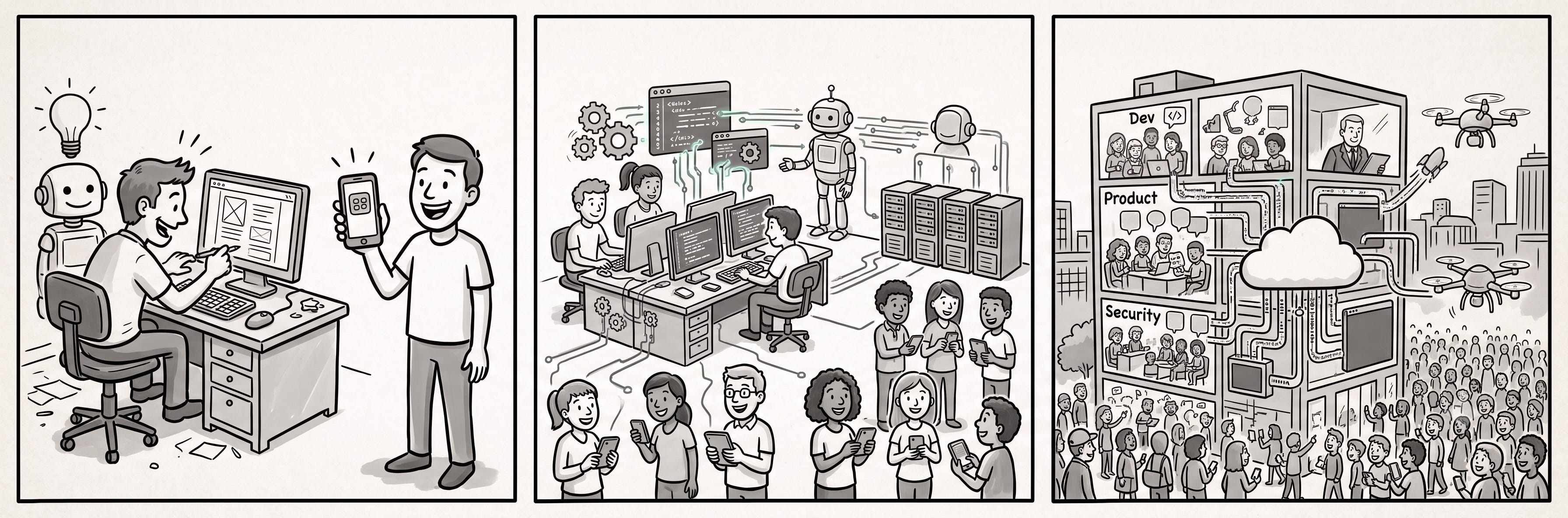
Stage 1: AI for Founders (From Idea to Customer One)
Tools like AI Studio and Lovable are making it far easier to discover ideas that might delight customers. These are fundamentally changing the feedback loop for how you iterate on rough concepts to form flows that customers might actually use or pay for.
But these ‘apps’ lack the things that are really needed for usage. Here are the things I’d do:
Get on a basic cloud stack. You can use Google Cloud services like Firebase and Cloud Run, or even other stacks like Vercel. Take your concepts from your prototype, save them in a repository, and get working with these providers.
Pick one AI model to start. Obviously I’d love if you used Gemini but GPT and Claude are really good at code, and helping bring users along. Time to value is the goal here, so pick one and get to know the ins and outs. Point it at your provider you picked, and your code, and get going. Don’ts: If you know a programming language already, great! But don’t get bogged down here yet. Your goal is getting to production for a customer as fast as possible, and realistically you’re going to refactor many times.
Build 3 tiers. AI models can help with this, but I sometimes find the fundamental issues people run in to are the blank paper problem. Prompt for 3 tier apps (this gives you a front end or UI, a backend set of services, and a database minimally). Important: Your data is your most valuable asset. Take the time to think about the data structures you’re going to need and spend more time here building this out. Other parts are fungible; your customer data is for life.
This is obviously not exhaustive, but based on questions I heard, doing these three things will get you somewhere between 60-80% of the way to being ready for your first customer.
Stage 2: Scaling to 100 Customers with AI-Native Processes
If moving from 0 to 1 is about code, 1 to 100 is about process. Once you have a running app, you can’t just pretend the current version doesn’t exist when you do more development. But this is where you can start scaling with AI native processes.
AI in product definition
You know your Lovable app that’s now a thing? Well, you can still use Lovable but now in a different format. Using things like Lovable MCP, or Stitch MCP make it easy for you to bring your iteration of your app to the code you’re iterating on and releasing. You can have both a fast iteration, and the means to connect this into your code and IDE’s to build faster.
AI for the code lifecycle
As you get building, you’ll need pipelines for deploying your code, and making changes so you won’t break them. Use AI to create Github actions or other cloud based actions that validate your deployment. Here, you’ll get more specific about your AI stack:
Define the common skills you’ll need for development. This may be product specific skills, or ways you’re doing development. Doing this now ensures your code will continue to be somewhat consistent as you scale.
Start using more advanced flows for agentic development like git work trees (to contain agents) and agent sandboxes. This will horizontally scale out your development capabilities without agents stepping all over each other.
Deploy basic AI agents to work on your behalf. Security agents and Code review agents are easy starting points. These can work with your coding agent or AI / IDE to build better code that you’ll deploy. Keep in mind there’s a tuning and iteration process here. Not all the recommendations will be relevant but they will help to present new options and considerations.
AI in the cloud
Here, an easy thing to do is make sure you have recommendations on wherever your code is deployed. These recommendations are typically cost or security focused but ensure you can build confidence running applications on the platform you picked.
Here, we also want to start setting usage quotas to ensure we are using our money and resources smartly. If you don’t know off hand what these should be, deploy your code, build up a baseline of metrics, and then ask for recommendations.
Things will also break. Ensuring you have telemetry enabled on your application / agent code will make it easier for your code agent or other agents to help you fix them. Ask for what to instrument based on your code and the platform; most agents will know how to do this.
By taking these actions, we’ve set up baseline activities and processes that will allow an AI first process to work.
Stage 3: Scaling to 1,000 Customers (AI Org Structure)
If the first two stages are about the individual or a team, the last stage is really about the organization and culture. Using AI here is harder: we have lots of code, lots of ideas, and lots of risk we need to manage.
What’s a good org structure and size for teams that use AI? While there’s no one answer, we are discovering teams of 20-50 with very clear charters tend to work better in an AI first build model. These teams are cross functional: everyone working on the product is a part of the team building the product at a trade off of strong function alignment. It makes sense in many ways: agentic development is more monolithic in that the flow is tightly coupled, but this does not work particularly well in organizations where the function (ex. engineering) is a monolith. We need to break apart these barriers to let teams move faster for end to end development.
Next, there’s a focus on AI automation. Where can AI take small tasks or toil work? These typically are things like fixing vulnerabilities or customer reported bugs. Here, the intake is likely your most impactful process. If you write a good bug report, AI is more likely to be successful at fixing it. Consider that documentation is an ally. Use AI to help with AI specific documentation, and build up your muscle for how to write effective plans with the help of AI. For example, you can use /grill-me mode in Antigravity to get a detailed plan of action. Now that you have running code, the plan is more important than ever.
Next Steps: Embedding AI into Your Engineering Culture
There are many other methods of which individuals have found success with AI. I’ve attempted to list out some of the most important or impactful things I’ve seen that have worked, or haven’t, but I hope this is useful depending on where you’re at to think about how to activate your teams with AI.